Most Recent Malfunction Bpc 157 Can Promote Injury Healing
Most Current Failure Bpc 157 Can Advertise Wound Recovery

Mass Order Tirzepatide
Stay clear of opening up the refrigerator to check on peptides, as this accelerates warming. Acquiring greater than you can use within refrigerated shelf life creates waste. For peptides you use regularly, keep rolling inventory that turns with prior to expiry. Compare outcomes in between fresh reconstitution and end-of-storage usage.Understanding The Landscape Of "peptides 4 Life"
The GHK-Cu peptide is a copper-binding tripeptide, and that copper atom adds an added measurement of instability. Copper can catalyze oxidation responses, potentially increasing the degradation of the peptide it is bound to and also surrounding particles. If you observe any cloudiness establishing during storage, gathering might have started, and the vial must be replaced. The TB-500 dose calculator can aid you prepare your reconstitution quantities to match your procedure size, reducing waste from run out vials.This simple technique stops forgotten vials from expiring extra. Decreased or absent expected impacts offer the most definitive destruction proof but require previous experience with useful product. Tracking outcomes gradually assists determine when destruction might have influenced a set. After reconstitution, the rubber stopper offers continuous security.That indicates the second half of your cycle delivers dramatically much less compound than the initial fifty percent. You might criticize the peptide quality, the vendor, or your own biology. Yet the real culprit was being in your fridge the whole time. The moment you include water to your peptide, you reestablish the really particle that drives deterioration. It is an active individual in hydrolysis, the chain reaction that cleaves peptide bonds one by one.
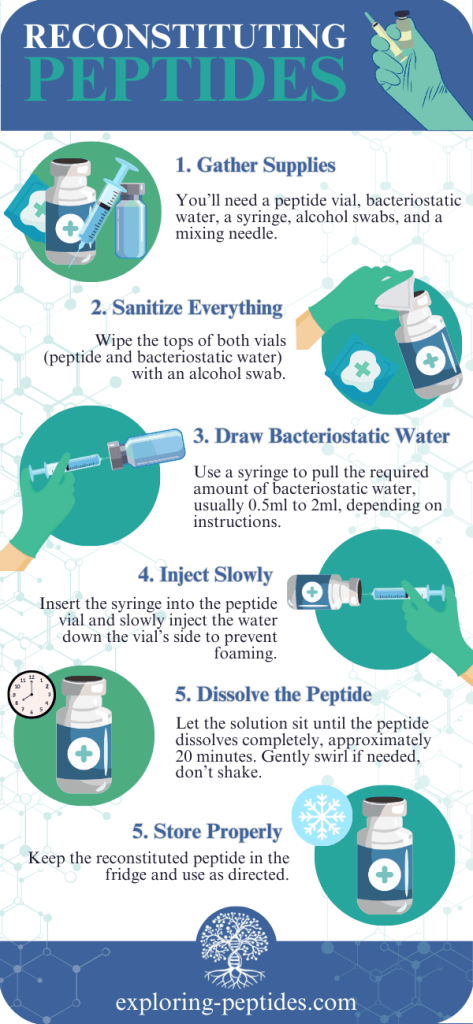
If your protocol requires a 28-day supply and your vial consists of enough peptide for 60 Have a peek here days of application at your picked concentration, do not reconstitute the whole vial simultaneously. Reconstitute just what you can utilize within the security window, or strategy to aliquot and ice up the excess instantly. Maintaining peptide in lyophilized type is constantly the most safe storage option. Find out more about powder-form stability to recognize why this issues so much.
- Properly kept lyophilized BPC-157 can stay practical for three or more years.
- Team peptides by current usage versus storage, label clearly, and track specific reconstitution dates.
- Every minute a peptide vial spends exposed to that light permits photodegradation to proceed, especially for peptides having aromatic amino acids.
- Some color change is typical for sure peptides, however significant changes necessitate care.
the year-plus duration of secured vials. Lyophilized peptides in sealed vials stand for one of the most stable storage space configuration. The freeze-drying procedure eliminates water, removing the main reactant for hydrolysis. Without water, the main deterioration path comes to be not available, leaving just slower oxidation and various other small reactions. If you intend to use lyophilized peptides within a couple of days or weeks, keep them in a fridge at temperature levels listed below 4 ° C( 39 ° F). Many peptides stay stable at room temperature for several days if kept away from warm and direct sunshine. Short periods unrefrigerated generally affect effectiveness rather than security. Return peptides to the refrigerator as soon as possible. Numerous peptides are dispensed in a lyophilized, or powdered, kind. These peptides have to be reconstituted with bacteriostatic water prior to injection. Safety factors to consider are paramount when discussing any kind of brand-new
Some distributors provide peptides currently packaged under nitrogen consequently. Tryptophan deterioration occurs primarily through light-induced oxidation. The aromatic ring system soaks up light power and produces singlet oxygen, which after that damages the deposit. This is why amber-colored vials and dark storage space are particularly essential for tryptophan-containing peptides. This is the pleasant spot for the majority of study applications. Standard lab freezers keep minus twenty levels dependably.